12/05/2011

Winter has arrived!


October brought with it a few inches of snow (7.6" to be exact)...that was ok. Then November left another 15.8" -- that was better and it seemed as if winter was off to a pretty good start. We're only a few days into December, and we've already had 30.3" of cold powdery snow (plus some chilly temps) this month. That totals 53.7" of snow (which contained 3.67" of moisture). The last four seasons have been really dry, so I am thrilled to see winter 2012 off to a snowy start. For comparison, all of last winter saw only 74.3", and the historic dry winter of 2002 brought only 48" total of snow. So, we are indeed off to a good start (the average annual snowfall for the past couple of decades is about 115"). Incidentally, the snow shoeing and cross country skiing in the park are excellent...the unplowed upper road is where I'll be heading later on today. Here are a couple of photos I took a few minutes ago...it's a winter wonderland out there, with the sun working its way through.

12/04/2011

Winter Wonderland Classroom


The Mountain Park has been receiving a lot of snow lately and the kids absolutely love it. Although there are a few days where the schools will opt out of participating in the days session due to weather conditions, most schools and classes do not stop when we get a good snow.

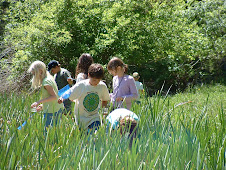
If the snow is deep enough the students don snow-boots and it's class as usual . . . although it's quite a different day from one spent indoors sitting at a desk. These students hike through out the snowy forests and get all of their days worth of educational standards by using the various aspects of nature as teaching opportunities.

One of the focuses for this month is the biology and identification of the trees in the Mountain Park. There are six prominent types of coniferous trees in the park, two Junipers, two Pines and two Fir. Although there are many differences between the different trees, the students are taught to focus on a few easy to discern traits such as the type of leaf (needles or scales) and their arrangement.

For example, the Douglas Fir [left] has very green needles that grow from the branch in all directions (like the spokes on Douglas' bicycle wheel!) . .

while the White Fir [right] has slightly bluish-green needles which are almost twice as long and typically grow from the sides of the branch and curve upwards.

It's also a great opportunity to begin to prepare them for next sessions focus which is on Mammals and Tracking by pointing out the occasional signs and quite frequent tracks of the various animals which make the Mountain Park their habitat.

Often we find the tracks of mule deer and fox and at times we have even come across tracks of wild cats such as the bobcat that we saw and got photographs and even a little video of last year. Of course various animal scat, especially from the many deer that visit the park, is quite prevalent and provides not only some frequent laughter from the students but also a lot of opportunities to segue into many on-topic conversations.

We also find signs of squirrel activity; the ponderosa branch tips on the ground around the drip-line of the trees, some of which have been stripped of their needles and bark due to the squirrels eating the sugary inner bark.

~Ranger David "Pine" Martin
Environmental Educator
Mountain Park Environmental Center

11/29/2011

A warm Day of Rocks and Soils and Mysterious Tracks!

The rescheduled school for yesterdays Earth Studies session was very lucky. An unseasonably warm day greeted us on our arrival to the park and we spent the day learning about Geology and Soil. The recent snow and subsequent melting combined perfectly with this days warm weather allowed us to get a really good sample of the soils in each ecosystem while enjoying the sunshine. It also made for a trail full of animal tracks in the now mostly dried mud of the trails. Stories played out in footprints abounded as the kids deciphered the mysterious language of the trail before them.

The hike into Devil's Canyon was magnificent and the water flowing under the ice was moving in dark and mysterious blob-like forms which completely captured the kids attention and brought up conversation about how it was like the blood stream of our bodies. Their personification of it was a great segue to speak to the importance of water on the planet as well as in such a dry state as Colorado. It was a great day out and the kids had a blast!

11/18/2011

Dichotomous Keys & Trying Not To Freeze


It was a pretty cold week for Earth Studies students, but we managed to find some sunny places to sit and learn about Trees and Wildland Fires. In the tree portion of the day these kids learn how trees grow and the different parts of the trees anatomy as well as learning to identify the various trees in the Mountain Park. They also learn how to age the Ponderosa Pines of the park (without cutting them down and counting the rings).


In the fire portion of the day these students are taught about the Mason Gulch fire which came within 4 -1/2 miles of the Mountain Park. Most students found forest fires to be much larger and more destructive than they had previously imagined them to be.

One thing I noticed this week was that as the children did the Tree I.D. exercise they no longer seemed to notice the cold.

Tree I.D.
combines a scavenger hunt element with the mystery of figuring out which of the six coniferous trees in the park is which. Students use a dichotomous key designed for the trees found in the Mountain Park; by examining the trees closely to answer the series of questions on the key they eventually arrive at the answer.

After doing about nine trees these kids could identify some trees just by looking at them at a relative distance.

This session goes a long way toward educating these kids about how nature works and how to better steward their park and other wild areas of Colorado. Their minds are opened up to new possibilities such as the idea that wildland fires are not good or bad, but just a natural and necessary part of the health of the ecosystems they have been studying.

11/11/2011

Society Is The Soil From Which Our Children Grow

~by Ranger David "Pine" Martin

“A child said What is the grass?
fetching it to me with full hands,
How could I answer the child?”
~Walt Whitman.

I was reminded of these lines from Walt Whitman’s poem Leaves of Grass yesterday when a student asked me a question during our Earth Studies session.

We were sitting in a circle amongst the Ponerosa Pines examining the soil created by that ecosystem; discussing the minerals, water, air and organic matter to be found in the samples each child had taken. We discussed the ways in which the forest of the past contributed a great deal to the rich, nutritive biotic content of the soil from which the forest of the present receives it's nutrients and water from.

A child held up something he had found in his small sample of soil. “What is this?” he asked. It was one of the small, orange, male pine cones.

I explained what it was, but this answer only served to generate more questions. One was, why are the female cones so much bigger than the male cones?” I explained that the female cone is an ovulate cone and has a big job; it must build a home for, create the seeds which carry all the genetic coding for the Pine tree to reproduce, and must house those seeds until they are dispersed which may take several years.

Often I am asked questions by students during Earth Studies programs to which I would love to answer in great depth and illuminate them at length to the amazing and elegant complexity of the living systems of the world around them. I would have loved to go into how wind tunnel analyses of the female cones have shown that the geometry of the cone’s structure itself aerodynamically enhances the probability of pollen entrapment.

A part of me, akin to Whitman, would love to ruminate on each question, take them deep, ponder and mull over the nuances and connections and through this generate a greater sense of meaning within myself and these children, imbue their worldview with a deep beauty. With the day’s time constraints and the short attention span of the Fifth Graders however, it is best to keep the answers brief and as “on-topic” or applicable to the session’s lesson as possible. Bring it back around. Show interconnectedness.

I woke up this morning with some deeper thoughts on this subject. What we do as Environmental Educators is a lot of seed planting; we know that not all seeds will take root, so we plant a lot. It occurred to me however, that not only are we planting seeds, but we are enriching the soil those seeds are planted in and that this, like the relationship between the soil and the trees in this ecosystem, will perpetuate itself. Environmental Educators not only teach the elements of the session at hand, but as adult members of their community and education system, we teach many other things by example. We show them our love of Nature and how to responsibly interact with our environment and each other. Earth Studies Co-Program Director John Duston once told me "We teach values." and I would have to agree with him wholeheartedly. Much of what we teach is through exhibiting our values by our behavior. We teach them that we value nature and value learning by fostering an outdoor classroom culture of cooperation, mutual respect, patience and enthusiasm. As we educate these young people our hopes are that it elevates the level of education, the sense of place and the values of our community and society at large as it grows and matures. Our intention is that each of these kids grows up strong, healthy, intelligent and happy.

Society is the soil from which our children grow; our children will become the society of the future and they will in turn become the soil from which their children grow.

10/28/2011

A flashback from the trail!

This keeps happening...I can be anywhere, doing anything, and suddenly a snapshot, a moment of being on the trail pops into my head. There doesn't seem to be any common instigator of it happening - it just happens. Here's one that popped up a couple of days ago, while walking home from the park: I am resting under a large tree, probably an Engelmann spruce, amongst a forest of lots of trees, after scooting rather quickly through an open area. It was an on again/off again rainy afternoon, and I was dealing with thunderstorms and the threat of lightning since late morning. I came to the edge of a forested area - I believe I was in Section 27 - and was concerned about moving out into a more open area with several smaller trees but also lots of exposure. There was a storm that seemed to be staying ahead of me, so I figured I was OK and set out. Around halfway across (it was about a half mile across), it began to rain hard and the storm's energy (and lightning) seemed way too close. So I moved as quickly as I could and made it safely into the next forested area. The rain was coming down, I had been hiking since around 6am and it was around 3:30pm, so I decided to find a protected spot to wait out the storm. I found a few large trees, took off my pack and leaned it against one of them, and sat down leaning against the pack. My poncho covered both me and the pack, so I was warm and dry, and so was my gear. I pulled out a snack - a Kind bar with lots of nuts - and sat there, resting, enjoying the snack (really enjoying it, as I recall, because I was hungry), and singing I Will by Paul McCartney while the rain continued. The rain did finally slow down and so I was soon back on the trail, looking to get a few more miles in before finding a decent place to camp (the rest of that day had several more "moments" that I'll write about one day). That was a pleasant break in a long, soggy day on the trail!

10/26/2011

A Taste of Winter Arrives!


The warm and gentle days that we've been enjoying this October have today been replaced by a generous blast of snow and cold. I am watching the snow come down steadily outside my window as I pause from typing these words. A few minutes ago, I stepped outside to capture a few scenes around the Horseshoe Lodge -- here's a couple of them. This is the first of hopefully many snows of the 2011/2012 snow season. And I'll be out there measuring. This morning at 8am, I measured 0.17" of moisture. Much of that fell overnight in the form of light rain, but it became snow towards dawn -- 1.7" of snow was on the ground then, and a few more have fallen since.